Facilitation & Scaling in Practice
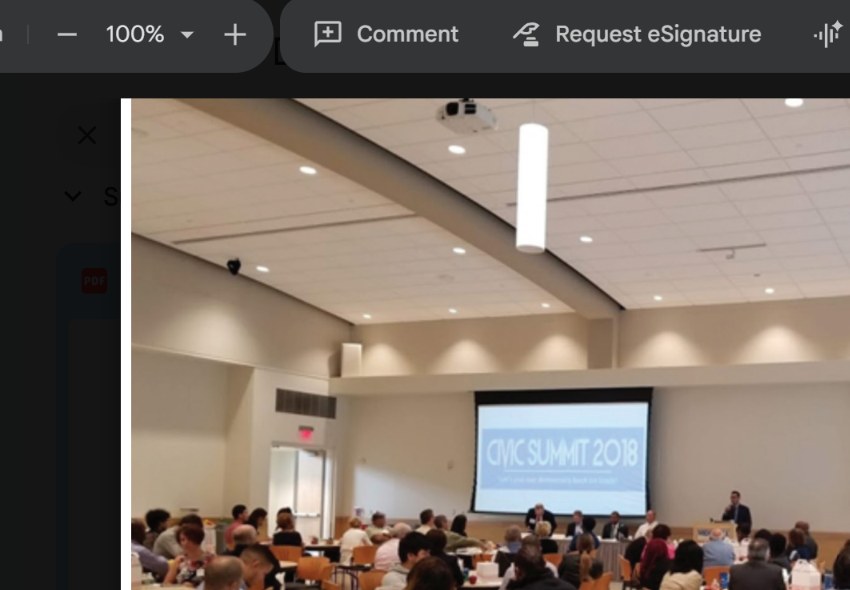
Turning practical citizen problem-solving into repeatable models for communities, schools and institutions.
Traditional civic education often explains how government is structured without teaching people how to participate in public problem-solving. The Citizens Campaign developed a different proposition: equip residents and students with practical tools for identifying issues, researching evidence-based solutions and bringing those solutions into public decision-making.
What if civic education taught people not simply how government works—but how to work with government to solve problems?
As Director of Civic Trust, Joel Rosa worked in the space between program design and local implementation—facilitating residents and community leaders, introducing civic problem-solving models, and helping educational and civic institutions understand how those models could operate in practice.
The Citizens Campaign's published materials document Rosa explaining Solutions Civics to Newark Public School principals. Its archived reporting also identifies him as facilitator of a Plainfield session where residents and community leaders learned the Civic Trust model and how to launch one locally.
The Citizens Campaign's Solutions Civics toolkit states that the model was being taught district-wide in Newark, Perth Amboy and Trenton, while being introduced in additional New Jersey districts and Philadelphia. The curriculum was designed as a compact ten-hour component with a concurrent hands-on problem-solving project—an example of making an ambitious civic concept implementable inside an existing institutional structure.
Turn abstract civic participation into a practical method people can see themselves using.
Translate the model for residents, school administrators, educators and community leaders without losing its core purpose.
Implementation becomes sustainable when the institution and participants can carry the work forward.
Curricula, toolkits, training and structured sessions make replication possible without dependence on one person.
Facilitation · Training · Stakeholder Engagement · Program Implementation · Institutional Adoption · Change Management · Public Policy · Curriculum Translation · Community Engagement · Scaling Strategy
Scaling an idea requires more than enthusiasm for the concept.
It requires adapting the model to different institutions, earning stakeholder ownership and creating enough structure for others to implement it without you. The experience taught me that sustainable change occurs when people understand not only what the idea is, but how they can make it work inside their own environment.